5 Budgeting Mistakes That Keep You Broke — And How to Fix Each One
In this article
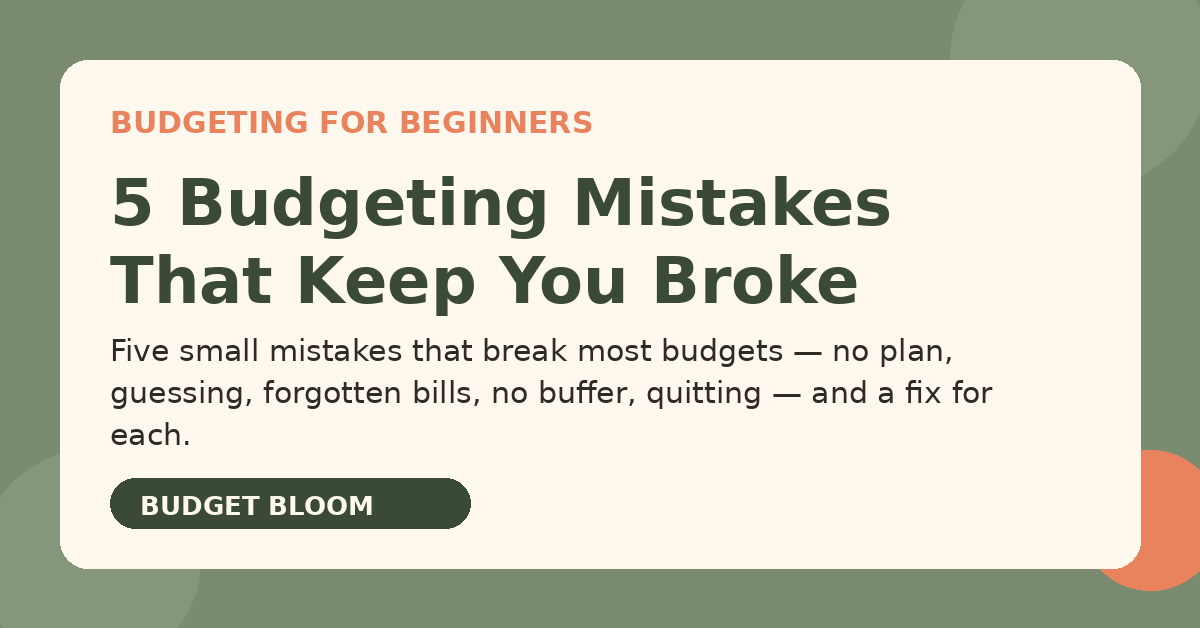
Most budgets do not fail because the person is bad with money. They fail because of five small mistakes that are easy to make and easy to fix. If your budget has never lasted past week two, one of these five is probably the reason.
The 5 Mistakes at a Glance
| # | Mistake | What it costs you | The fix |
|---|---|---|---|
| 1 | No written plan | Every dollar is a guess | Write the plan before payday |
| 2 | Guessing your spending | You undercount by hundreds | Track one real month first |
| 3 | Forgetting irregular bills | A $600 bill wrecks the month | Save $50 a month for them |
| 4 | No buffer at all | One surprise = debt | Keep a $100 buffer line |
| 5 | Quitting after one bad month | The plan never gets a second chance | Fix one line, keep going |
Mistake 1 — No Written Plan
A budget in your head is not a budget. Money with no written job gets spent on whatever is in front of you. Fix it before payday: write down your income, then give every dollar a job — rent, food, bills, debt, savings — until the total is zero. Our Budget $1,500 a Month With 50/30/20 plan shows a complete written plan, and our Budget on a Low Income plan does the same for $2,000. Copy the shape, use your own numbers.
Mistake 2 — Guessing Your Spending
Most people guess they spend $300 on food when the real number is $450. Guessing makes the budget impossible from day one. Fix it by tracking one real month first — every coffee, every delivery, every small shop — before you set limits. Use the 10-minute weekly check from our Track Your Spending in 10 Minutes a Week guide, or start with the seven steps in Stop Living Paycheck to Paycheck. A budget built on real numbers is one you can actually keep.
Mistake 3 — Forgetting Irregular Bills
Car insurance, annual subscriptions, car repairs — they are not surprises, they arrive every year. But if they are not in the monthly budget, a $600 bill lands like an emergency. Fix it with sinking funds: divide each yearly cost by 12 and save that amount monthly. $600 a year is $50 a month. Our Sinking Funds for Beginners guide sets up five funds that total $190 a month — including car, home, and annual bills — so nothing arrives unannounced.
Mistake 4 — No Buffer at All
A budget with zero slack breaks at the first surprise: a flat tyre, a medicine bill, a school cost. Then the card comes out, and the budget feels pointless. Fix it by adding a $100 buffer line to every month — money with no job except absorbing surprises. If the month goes well, the buffer rolls into savings. That one line is also step 4 in our Stop Living Paycheck to Paycheck plan: build a $500 buffer, $100 at a time.
Mistake 5 — Quitting After One Bad Month
One overspend does not mean the budget failed — it means one line was wrong. Most people quit after a bad month and go back to guessing for six more months. Fix it by treating the budget as a draft: after a bad month, change one line only — raise food by $50, cut one outing — and keep going. The budget that survives three months is the one that works. Our Save $500 Fast moves can cover a bad month without touching the plan.
FAQ
How long before a budget starts working? About three months. Month 1 is guessing, month 2 is correcting, month 3 is the first month the numbers feel real. Do not judge a budget on month 1.
Should I budget every single dollar? Yes — but "every dollar has a job" includes fun money and a buffer. A budget with no fun money is a budget you will break. Give yourself a small, fixed fun amount and spend it guilt-free.
What if my income changes every month? Budget on your lowest recent month, not your best one. In a good month, send the extra straight to savings or debt — as in our Pay Off $5,000 of Debt in 12 Months plan — before it becomes spending.
Conclusion
Five mistakes, five fixes: write the plan before payday, track a real month before you set limits, save $50 a month for irregular bills, keep a $100 buffer, and never quit after one bad month. Fix one mistake this week, and your budget stops being a wish and starts being a plan that actually lasts.
New here?
Start with the plan that matches your next money goal, and save the pin so you can find it again.
Follow Budget Bloom on Pinterest