How to Save $5,000 in a Year — $1,250 Every 3 Months
In this article
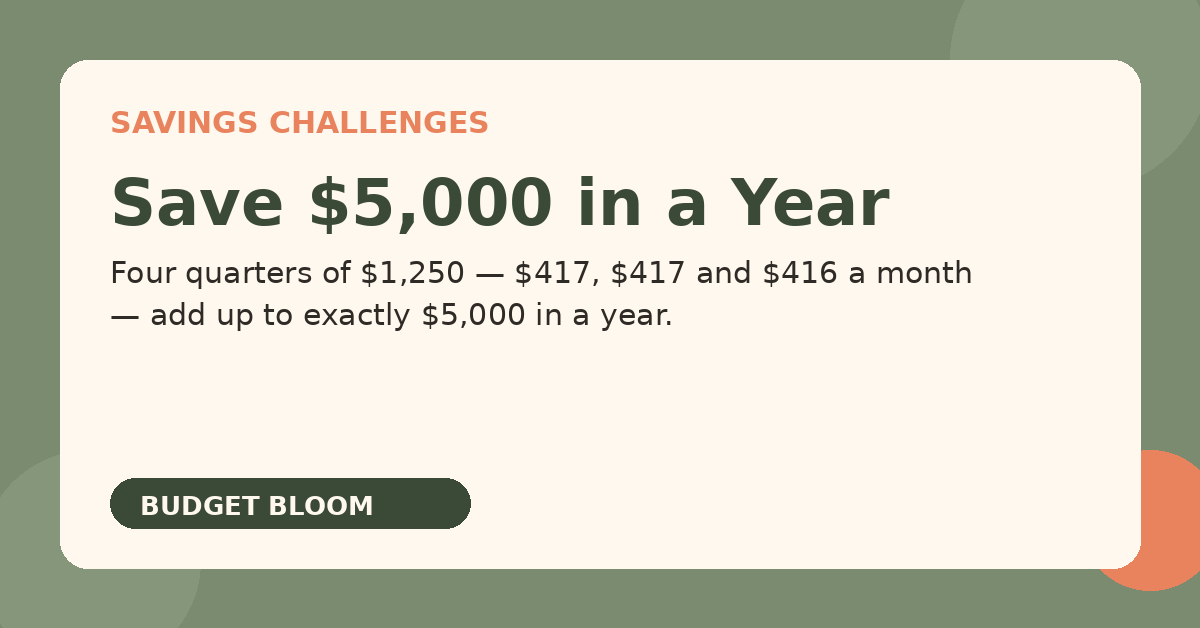
Saving $5,000 in a year sounds big until you split it into quarters. Four quarters of $1,250 add up to exactly $5,000, and each quarter is just three months: $417 + $417 + $416 = $1,250. Do that four times and the year is done. No windfall needed, no extreme month — just a steady amount, saved before you can spend it.
The Year at a Glance
| Quarter | Month 1 | Month 2 | Month 3 | Quarter total |
|---|---|---|---|---|
| Q1 | $417 | $417 | $416 | $1,250 |
| Q2 | $417 | $417 | $416 | $1,250 |
| Q3 | $417 | $417 | $416 | $1,250 |
| Q4 | $417 | $417 | $416 | $1,250 |
| Year total | $5,000 |
Check the maths: $417 + $417 + $416 = $1,250 per quarter, and $1,250 x 4 = $5,000.
Step 1 — Open a Separate Savings Account
If the $417 sits in your spending account, it will get spent. Open a separate savings account — even a free one at the same bank — and name it "My $5,000". On payday, move the money the same day. This is the same pay-yourself-first habit from our Stop Living Paycheck to Paycheck plan: the transfer happens before spending starts, not after.
Step 2 — Find the $417 in Your Current Budget
You do not need to find $417 from nowhere. Most people can find it in three places:
- One big cut ($200): Cook at home most nights, like our Meal Plan on $100 a Week — a home-cooked week can easily free $200 a month compared with eating out and delivery.
- Two small cuts ($117): Pause one subscription and pack lunch twice a week — the same swaps as our Save $100 a Month guide, which finds $100 with five small swaps.
- One extra move ($100): Sell one unused item a month, or take one no-spend weekend — our 10 Easy Ways to Save $500 Fast list has ten moves with exact dollar amounts.
$200 + $117 + $100 = $417. If your month is tighter, start with $200 and raise it by $50 each month until you reach $417 — the quarterly total can still be met by catching up in month 3.
Step 3 — Automate It on Payday
Set an automatic transfer for payday: $417 on the first payday of the month, and $416 in the third month of each quarter. Automation beats willpower every time. If payday is weekly, split it: about $96 a week also works — $96 x 52 weeks is $4,992, so add $8 in the last week to reach exactly $5,000.
Step 4 — Track Each Quarter, Not Each Day
Check your balance four times a year, at the end of each quarter. After Q1 you should see $1,250, after Q2 $2,500, after Q3 $3,750, and after Q4 $5,000. Checking daily only adds stress; checking quarterly shows real progress. If a quarter falls short by $100, add $50 in each of the next two months — small catch-ups, never a panic month.
What to Do With the $5,000
Decide the job for the money before you start, so a good month does not become a spending month:
- No emergency fund yet? This is a full fund. Our Save $300 in 4 Weeks plan starts one — this plan finishes it.
- Carrying debt? Send it to your smallest balance, as in our snowball plan — $5,000 clears a whole debt, not just a payment.
- Already covered? Keep it as your buffer so next year starts at $5,000, not zero — and start the next year with the same quarterly habit.
FAQ
What if I cannot save $417 in month 1? Start with what you can — even $150 — and raise it by $50 a month. You will reach $417 by month 6, and you can still finish the year close to $5,000. A slower start beats no start.
Should I save $417 even when I have debt? Keep a small emergency buffer first — $300 to $500 — then split the rest: most of the $417 to debt, some to savings. Our Pay Off Credit Card Debt Fast guide shows why extra payments save so much interest.
What if an emergency eats my savings mid-year? That is what the money is for. Use it, then restart the quarterly count from where you are. The plan is a habit, not a punishment — a used emergency fund did its job.
Conclusion
$5,000 in a year is four quarters of $1,250, and each quarter is $417 + $417 + $416. Open a separate account, find the $417 with one big cut and a few small ones, automate it on payday, and check in four times a year. By this time next year, the money is there — and the habit that built it stays with you.
New here?
Start with the plan that matches your next money goal, and save the pin so you can find it again.
Follow Budget Bloom on Pinterest